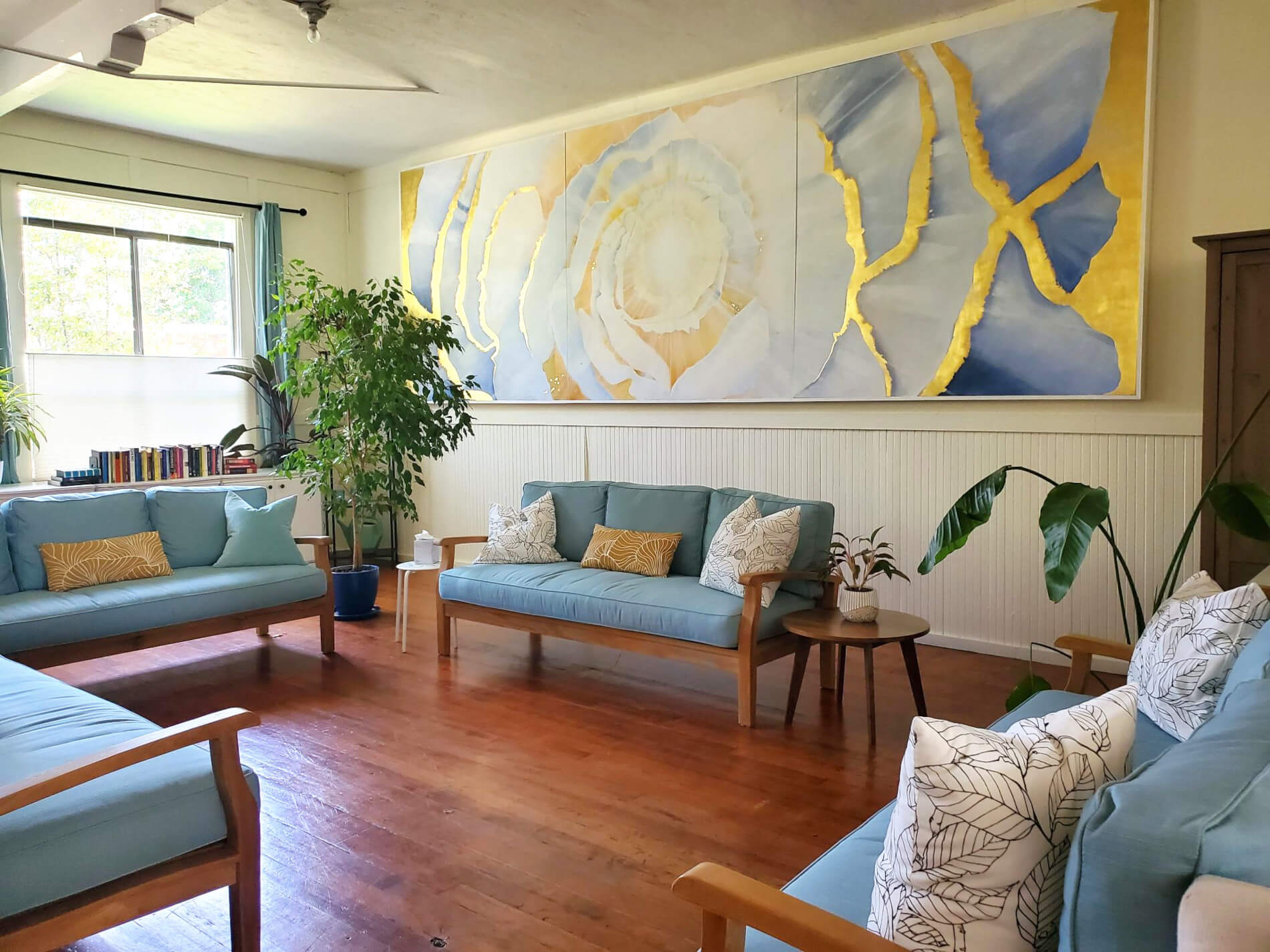
What Neuroaesthetics Is — and Why It Changes Everything About How We Design Spaces
There is a moment — you will know it — when you walk into a room and something shifts. The pace of your breath changes. Your shoulders drop. The background noise of your mind quiets, just slightly, and you become more present than you were a moment before.
We tend to attribute this to vague things. Good taste. The right light. A certain quality of atmosphere. But a growing body of scientific research suggests something more precise is happening — and that understanding it could fundamentally change the way we think about art in designed environments.
The field is called neuroaesthetics. And what it is beginning to show us is that the experience of beauty is not a luxury, a preference, or a cultural convention. It is a biological event.
What Neuroaesthetics Actually Is
Neuroaesthetics is the scientific study of how the brain responds to aesthetic experience — to art, music, architecture, design, and natural beauty. It sits at the intersection of neuroscience, psychology, and the arts, and it has been growing steadily since neuroscientist Semir Zeki coined the term in the late 1990s.
The field asks questions that were once considered too subjective for science: What happens in the brain when we encounter something beautiful? Why do certain images calm us? Why does the quality of a space affect how we feel, think, and heal? And perhaps most importantly for those who design environments: can aesthetic experience be intentionally used to support human wellbeing?
The answer, increasingly, is yes.
Susan Magsamen, founder of the International Arts + Mind Lab at Johns Hopkins University School of Medicine, defines neuroaesthetics as “the study of how arts measurably changes the body, brain, and behavior and how this knowledge is translated into practice.” Her 2023 book ‘Your Brain on Art’, co-authored with Google design executive Ivy Ross, synthesised this emerging research for a general audience and became a New York Times bestseller — a signal of how hungry the wider world is for this conversation.
As Magsamen writes, “the world is hungry for ways to heal, thrive, and flourish” — and the science of neuroaesthetics is beginning to provide a rigorous framework for understanding how the arts can meet that need.
What Neuroaesthetics Actually Is
The findings coming out of neuroaesthetics research are, in many ways, confirmations of what artists, healers, and practitioners of inner traditions have understood for centuries. But confirmation matters. It changes what is possible in the design of healthcare environments, wellness practices, and institutional spaces.
Art activates the brain’s reward systems. Engaging with art can stimulate the brain’s reward centres, producing dopamine and promoting feelings of wellbeing. Visual art also engages the prefrontal cortex, which plays a key role in executive function and decision-making — areas often compromised in patients with psychiatric disorders. This is not a metaphor. It is measurable neurochemistry.
Aesthetic environments reduce stress physiology. Research has shown that exposure to aesthetically pleasing environments — whether through artwork, architecture, or nature — can reduce stress, improve mood, and even promote physical healing. Hospital patients with access to natural views or art installations recover more quickly and require less pain medication than those in sterile environments. The landmark 1984 study by Roger Ulrich, which found that surgical patients with a window view of trees needed fewer strong pain medications and left hospital sooner than those facing a brick wall, was among the first to quantify this effect. Decades of research have followed.
Even brief encounters with original art shift measurable outcomes. A 2025 study found that viewing original artworks for just 20 minutes produced an average 22% drop in cortisol — the body’s primary stress hormone — along with reductions in inflammatory markers linked to chronic stress. For designers specifying art for waiting rooms, consultation spaces, or therapy rooms, this has direct implications: the work on the walls is not decorative. It is part of the clinical environment. And the quality and presence of that work appears to matter.
The reflective response to art is neurologically distinct. Research cited in a 2024 Frontiers in Human Neuroscience review found that when an artwork is experienced as deeply moving or resonant, it activates the brain’s default mode network — the same network associated with self-reflection, meaning-making, and states of inner attention. This suggests that art which carries genuine presence and personal significance engages us at a deeper level than art that is merely pleasant.
Why This Matters for Designed Wellness Spaces
A 2025 review published in the journal ‘Buildings’ by researchers at the Penn Center for Neuroaesthetics found that across studies spanning four decades and ten countries, visual art in healthcare environments — including nature imagery, paintings, murals, and artistic photographs — consistently produced measurable effects on patient experience and wellbeing.
This is significant for anyone involved in the design of wellness environments — functional medicine clinics, integrative health practices, retreat centers, therapy offices, meditation spaces. The art on the walls is not the finishing touch. It is a design decision with physiological consequences.
Neuroaesthetics can inform the design of healthcare environments to promote healing — but only if those commissioning and specifying art understand what the research is actually saying. And here is where much current practice falls short: the art chosen for wellness environments is frequently generic, flat, and selected for inoffensiveness rather than presence. It fills space without doing the work that art, at its best, is capable of doing.
The research does not suggest that any art will do. It suggests that art which engages, which carries meaning, which creates a felt sense of calm or spaciousness or beauty, produces measurable effects. The distinction matters.


Ancient Wisdom, Modern Confirmation
What makes neuroaesthetics particularly compelling is how consistently it confirms what non-Western and inner traditions have practiced for millennia.
Feng shui understood that the placement and visual and energetic quality of objects in a space directs life force (chi) and influences the wellbeing of those who inhabit it. Tibetan sacred art was created with precise understanding of how imagery, color, and geometric form affect states of consciousness. Medieval cathedral builders worked with light, proportion, and symbolic form to evoke awe, stillness, and a sense of the transcendent.
And further back still, the Neoplatonic philosopher Plotinus wrote in the third century that beauty was not merely pleasing form — it was the reflection of a deeper order, a resonance with what is most real and unified in us. For Plotinus, the experience of beauty did not end with the eye. It moved inward, elevating the soul toward its own essential nature. Beauty, in his understanding, was a pathway — not decoration, but revelation.
None of these traditions had fMRI scanners. But they had millennia of careful observation of what beauty does to human beings in spaces. Neuroaesthetics is, in a sense, building the scientific vocabulary to describe what they already knew.
This convergence is not merely interesting. It is practically useful. It means that artists whose work emerges from sustained inner practice — whose creative process is informed by an understanding of inner states, symbolic language, and the energetic qualities of color and form — are working with precisely the material that the research suggests matters most in healing environments.
What This Means in Practice
For interior designers and art consultants working in the wellness and healthcare sector, neuroaesthetics offers both validation and challenge.
The validation: your instinct that art matters — that the choice of what goes on the wall has real consequences for the people in the room — is now supported by a growing body of evidence. You can make that case to clients with confidence.
The challenge: not all art produces the same effects. The research consistently points toward art that is meaningful, engaging, and visually coherent — art that creates a felt response rather than simply filling space. Generic stock prints, purely decorative abstraction, and art selected primarily for colour matching are unlikely to produce the wellbeing effects the research describes.
The questions worth asking when specifying art for a wellness environment begin with the space itself: What is the intent and function of this room? How would we like people to feel here? What is the most important thing that could happen for people in this space? And what artwork will support that?
From there, the questions turn to the work itself: Does it invite stillness? Does it offer a place for the eye and the mind to rest? Does it carry a quality of presence that outlasts a first glance? Does it support the rejuvenation and restoration that the space itself is designed to offer?
These are aesthetic questions. But neuroaesthetics is beginning to show that they are also clinical ones. (A deeper exploration of how specific artworks can function as visual anchors within a space — and what to look for when selecting them — is coming in a future article in this series.)
This question is not abstract for me. For nearly a decade I created site-specific murals for private clients across the US, and abroad working with the specific intention of shaping the atmosphere of a room. Alongside that, I spent sixteen years living and working in retreat centers — maintaining the practice spaces and meditation halls where participants came seeking genuine transformation. You learn quickly in that context that a space either supports that possibility or it doesn’t, and that the visual and energetic quality of the environment is never incidental to the outcome. Long before I encountered the language of neuroaesthetics, I was working with exactly the questions the research is now describing.
Further Reading
For those who want to go deeper into this field, the following are excellent starting points:
– Your Brain on Art: How the Arts Transform Us” — Susan Magsamen and Ivy Ross (2023). The most accessible overview of neuroaesthetics research for a general audience.
– Penn Center for Neuroaesthetics — neuroaesthetics.med.upenn.edu. A leading academic research hub with freely available publications.
– International Arts + Mind Lab, Johns Hopkins — hopkinsmedicine.org/pedersen-brain-science-institute/international-arts-mind-lab. Research, resources, and the field’s most prominent applied neuroaesthetics initiative.
– “Benefits of Nature Imagery and Visual Art in Healthcare Contexts” — Cardillo & Chatterjee, ‘Buildings’, 2025. A rigorous review of four decades of research on visual art in healthcare environments.
– “Neuroaesthetics: Exploring the Role of Aesthetic Experience in Neurorehabilitation — ‘Frontiers in Psychology’, 2025. Current research on how aesthetic experience supports neurological and cognitive recovery.
– “The Enneads” — Plotinus. The foundational text for understanding beauty as a philosophical and spiritual pathway, and a fascinating counterpart to the contemporary neuroscience.
Yohanna Jessup is an artist whose work sits at the intersection of sustained inner practice, geometric form, and the design of rejuvenating and restorative spaces. With twenty years living and working in retreat centers, and a decade of creating site-specific environmental paintings for clients internationally, her practice is grounded in direct experience of what spaces ask of the people inside them. Archetype & Hourglass creates paintings and large-scale installations for wellness environments, retreat centers, and spaces of healing and reflection.


