
From Transitional Space to Sacred Center: What One Painting Did for a Berkeley Meditation Community
There is a particular kind of room that many organisations know well. It is used, but not quite inhabited. People pass through it, hold occasional events in it, perhaps eat lunch there. But it never quite becomes what it was intended to be. It lacks the quality that would make someone want to linger, to gather, to return.
For the meditation center in Berkeley, California, that room was their communal lounge — the heart of the building in theory, but in practice a transitional space. Though the center was home to a vibrant community of meditators, instructors, and volunteers, the room remained underutilised. “People milled around,” the facilities manager recalled. “We didn’t have a focal point.”
What happened next offers one of the clearest illustrations of what large-scale art can do for a shared community space — and why the way art is created matters as much as what is created.
The Brief
The center approached Archetype & Hourglass with a clear intention but an open question. They knew what they wanted the room to feel: a space that could carry the spirit of the center’s community into the future, that reflected its values of peace, unity, and connection, and that gave people a reason to gather rather than simply pass through.
What they needed was a focal point. Something that could anchor the room and the people within it.
The facilities manager put it simply: “We wanted something that could draw people in — a centerpiece.”
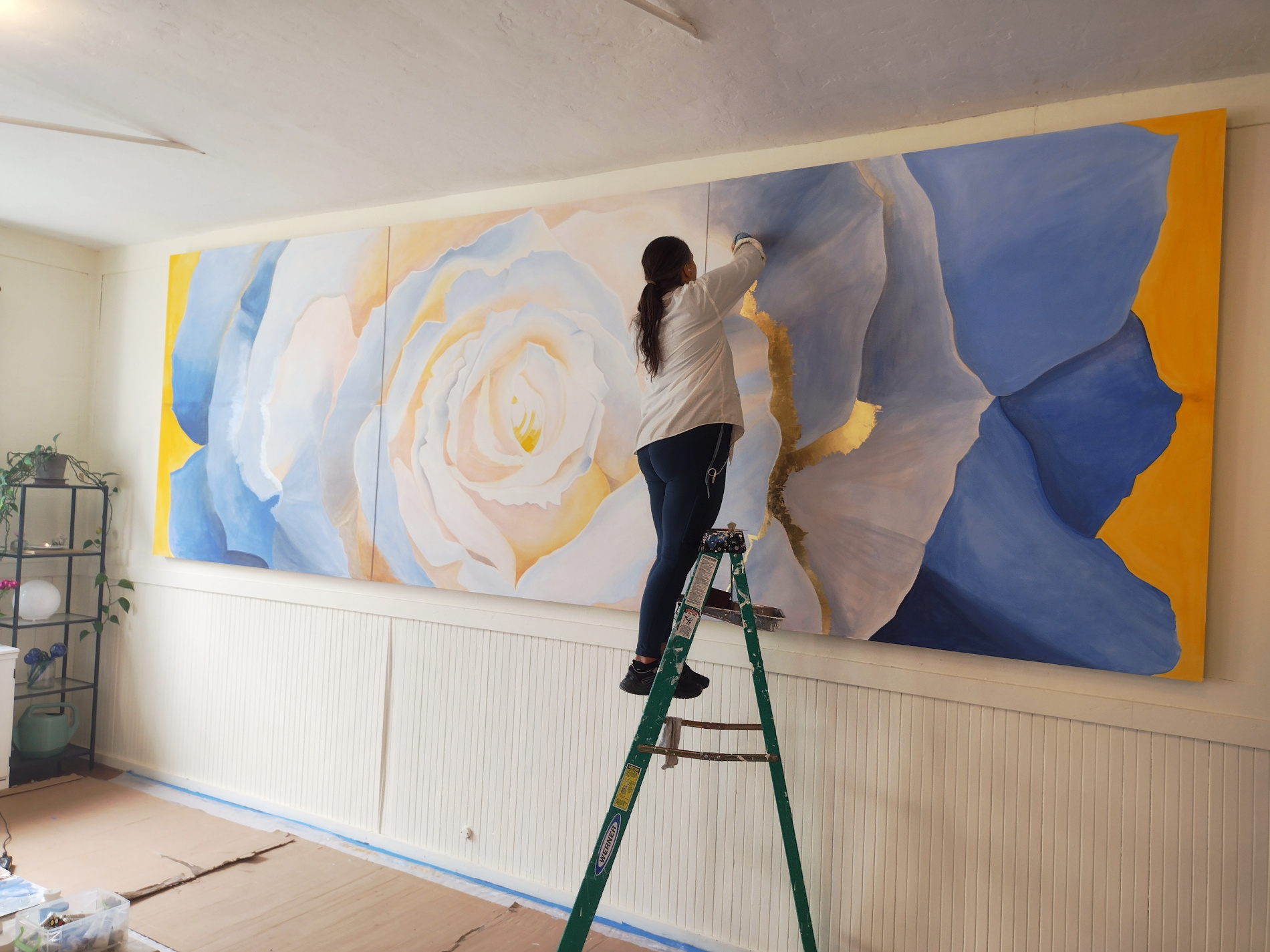
The vision that emerged was ‘Peace Rose’ — an 18 ft × 6 ft painting in water-soluble wax paint and 24k gold leaf, created directly on site over several weeks in 2022. But the scale of the work was only part of the story. What made this project distinctive was the decision to make the creation of the painting a community event in itself.
Art of the Community, Not Just for It
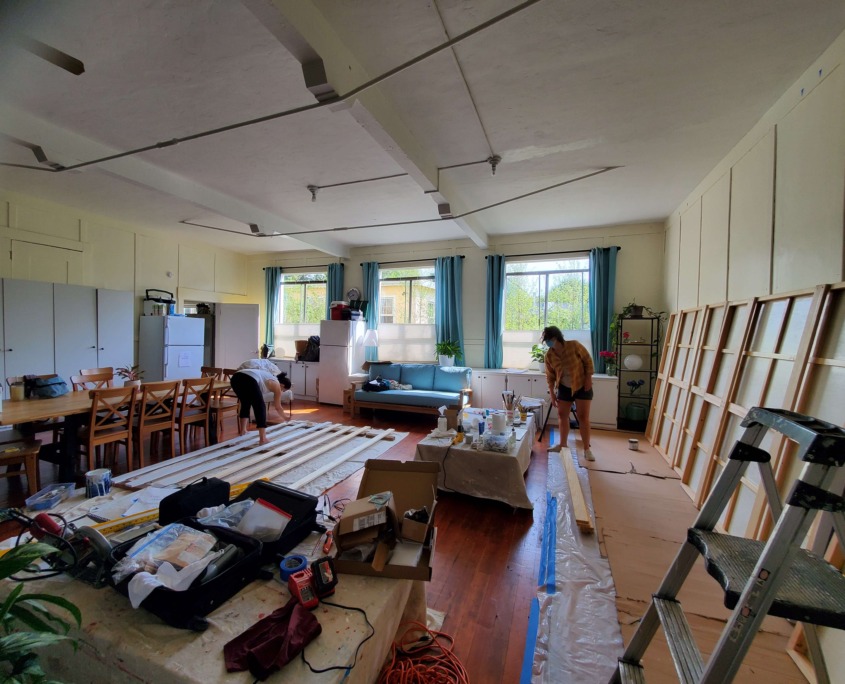
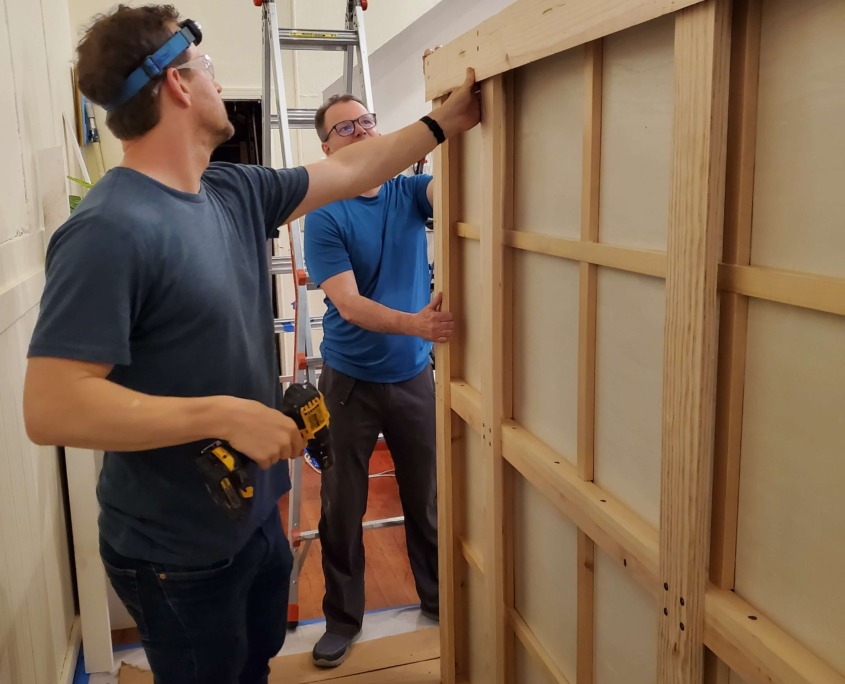
From the outset, the process was designed to involve the community rather than present them with a finished object. Volunteers helped construct and paint the frame. Weekly progress updates were shared during meditation classes. Members watched the painting grow on the wall over weeks, returning to find it changed, deepened, further along its journey toward completion.
The unveiling itself was a collective moment: a talk by the artist, followed by a group meditation practice with the completed work.
The effect of this process on how the community experienced the painting was profound. “People got invested,” the facilities manager said. “That’s part of what gave the painting its power.”
This points to something that goes beyond aesthetics. When a community participates in the creation of an artwork — even in small ways, even as witnesses — the artwork carries a different kind of weight in the space. It is not something that arrived from outside. It was made here, with us, for this. That felt ownership changes how people relate to both the work and the space it inhabits.
What Changed
The transformation was immediate and has proven lasting.
Before the installation, the communal room felt, in the words of one community member, like “a collection of mismatched elements rather than a cohesive whole.” After?
“Somehow the space came to life. There was a different vibe. It took the space into the extraordinary.”
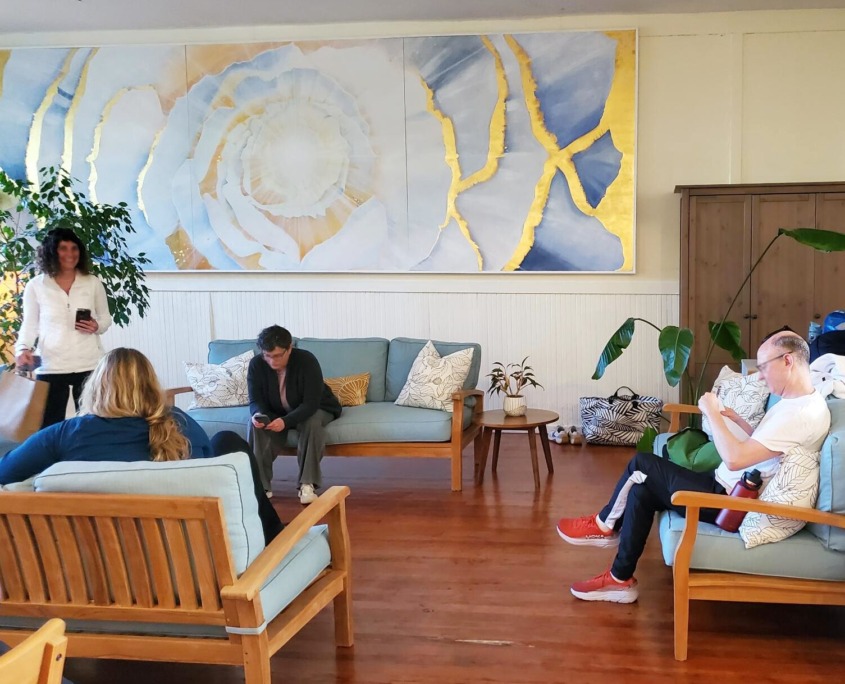
Meetings began to be held there. Students — new and returning — were drawn to the room. The painting became, as the facilities manager described it, “a grounding point. It interacts with consciousness. It helps people center themselves.”
What is perhaps most striking is this observation: even when the room was physically cluttered — chairs moved, materials left out, the general disorder of an active community space — the painting gave it clarity. The focal point held. The atmosphere it created proved more durable than the physical state of the room around it.
This is exactly the quality that distinguishes anchoring art from decoration. Decoration is affected by its environment. Anchoring art affects its environment.
The Legacy
Three years on, ‘Peace Rose’ continues to define the space and the community’s relationship to it.
International students visit the center specifically to see the painting. It has become a “wow” moment — an unexpected encounter with something larger than they anticipated. The former facilities manager, now visiting as a guest rather than a staff member, observes that people still tune into it. “It’s a piece that brings people into themselves and into the space,” she said.
And when asked what she would say to other organisations considering a similar commission, her answer required no deliberation:
“Do it. Don’t even think about it. It will transform your space — and your community.”
What This Means for Organisations
The Peace Rose project illustrates several principles that apply beyond this particular commission.
A room without a focal point is a room without an atmosphere. The lounge was not broken before the painting arrived. It was simply unanchored. The painting gave the space a reason to cohere — and people responded to that coherence instinctively, without being told to.
The process of creation is part of the impact. For organisations working with a defined community — meditation centers, retreat spaces, integrative health practices, schools — involving that community in the creation of a large-scale work deepens the relationship between the artwork and the people who will live with it. The investment of time and attention during creation becomes part of what the finished work holds.
Scale matters, but it is not everything. An 18 ft painting creates a powerful statement. But the principles at work — focal point, contemplative depth, community resonance — operate at many scales. The question for any organisation is not “can we commission something this large?” but “what does this space need to anchor it, and what would it mean to involve our community in bringing that into being?”
Art made for a space outlasts the decisions that surround it. Furniture is replaced. Decor is updated. But a work created with genuine intention for a specific space and community tends to deepen over time rather than date. Three years after *Peace Rose* was unveiled, it is still the first thing people see when they enter that room. It is still drawing people in.
A Note on the Full Case Study
This article draws from the Peace Rose project, documented in full on the Archetype & Hourglass website. The full case study includes before and after photography, process images, and the complete account of the community engagement process.
Archetype & Hourglass creates site-specific paintings and large-scale installations for wellness environments, meditation centers, retreat spaces, and organisations whose spaces are designed for healing, reflection, and community. Every commission begins with a conversation about what the space needs to hold.

