
Color as Medicine: What Research Tells Us About Palette Choices in Healing Environments
Color is the first thing a room communicates. Before anyone reads a sign, speaks to a practitioner, or settles into a chair, the palette has already begun its work — signaling safety or alertness, openness or enclosure, warmth or clinical distance. In most environments this happens without design intention. In healing environments, it cannot be left to chance.
The research on color in healthcare and wellness settings has grown substantially in recent years, and what it reveals is both more nuanced and more actionable than the broad generalisations that tend to circulate in design circles. Blues are calming — true, but not the whole story. Gold is beautiful — also true, and also something more. Understanding what the research actually says, and how it connects to centuries of intuitive color practice in sacred and contemplative traditions, gives designers and practitioners a more reliable foundation for the decisions that shape how patients and clients experience a space.
What Color Actually Does
Color affects us at multiple levels simultaneously — psychological, physiological, and neurological — and the effects are measurable.
A 2024 systematic review published in the ‘Shiraz E-Medical Journal’ synthesised findings from studies across clinical environments and found that color in healthcare settings has a measurable impact on patient outcomes including mood, satisfaction, and recovery rates. Cool colors — blues and greens — were consistently linked to calming effects, reduced anxiety, and in some cases lower blood pressure. Warm colors — yellows and oranges — were associated with feelings of comfort and warmth but could increase anxiety in some patients when used intensively. Neutral tones provided balance but risked feeling sterile when overused.
A 2026 review in the ‘International Journal of Recent Advances in Psychology and Psychotherapy’, drawing on 72 peer-reviewed studies published between 1990 and 2025, found that lighter colors — particularly blue, green, yellow, and white — consistently enhanced mood, reduced stress, and promoted physiological calm. The researchers concluded that color should be understood as an environmental determinant of health, alongside factors like lighting, noise, and air quality.
This is not a minor repositioning of how we think about palette choices. It places color in the same category as clinical decisions — as something that demonstrably affects outcomes.
The mechanisms are biological. Color reaches us through photoreceptors in the eye that transmit signals to brain regions governing emotional response and autonomic nervous system regulation. Green and blue appear to activate neural pathways associated with calm and safety — pathways that, from an evolutionary standpoint, were tuned to respond to environments rich in water and vegetation, the conditions our ancestors associated with rest, recovery, and abundance. Red activates arousal and alertness. These are not purely cultural associations. They are, to a significant degree, biological ones.
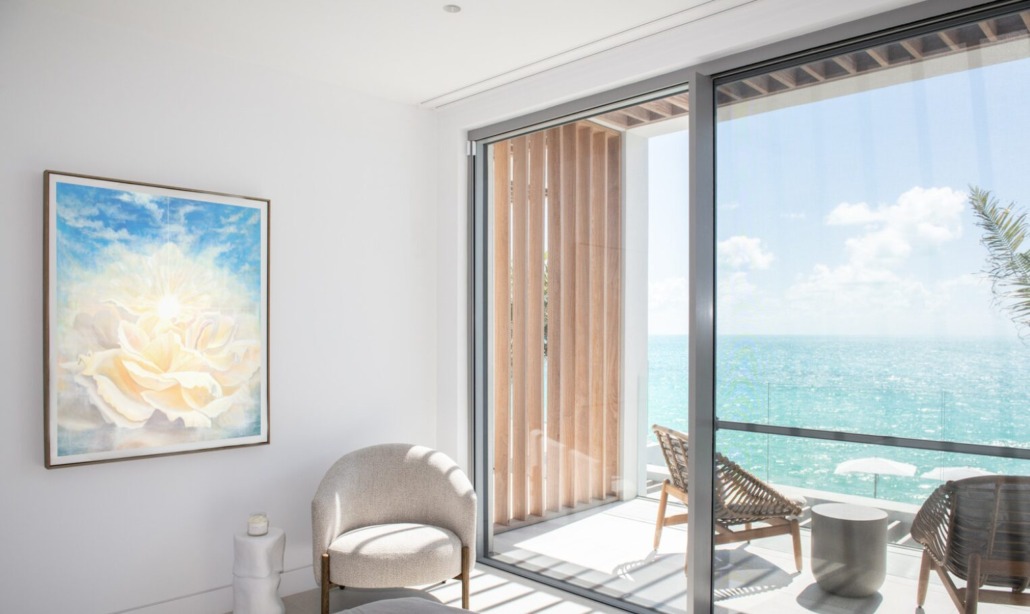
A print of Sky Rose in a resort room. Calming blues, blue-green, and gentle warmth.
What Works — and What Doesn’t — in Healing Spaces
The research points consistently toward certain principles for wellness environments, integrative health practices, and retreat spaces. These are not rigid rules — individual variation, cultural context, and the specific function of each room all matter — but they represent reliable starting points.
Blues and blue-greens: the most versatile calming palette.
Soft blues and blue-greens consistently perform well across patient rooms, waiting areas, consultation spaces, and corridors. Blue is associated with tranquility, trust, and stability — particularly valuable in spaces where patients arrive carrying anxiety. A 2020 study using heart rate variability assessment found that blue rooms produced the lowest levels of arousal of all colors tested, making them well-suited to environments designed for rest, reflection, and therapeutic presence. Lighter, muted blues tend to work better than saturated or dark navy tones, which can read as cold or formal.
Greens: nature, restoration, and balance.
Green is the color most consistently associated with nature, growth, and healing across both research and contemplative traditions. Studies have found it reduces anxiety, promotes a sense of balance, and creates a felt connection to the natural world — the same effect documented in research on biophilic design. Soft, medium-toned greens — those that evoke foliage, water, or moss rather than institutional tile — are among the most effective choices for patient rooms and spaces designed for longer stays.
Earth tones: grounding without sedation.
Warm neutrals — stone, clay, sand, warm grey, terracotta — create environments that feel grounding and human without the stimulating effect of brighter warm tones. They tend to work particularly well in reception areas, corridor spaces, and communal rooms where a quality of comfort and belonging is more important than active calming. Research on waiting room design has found that patients prefer neutral saturation — neither overly saturated nor completely stripped of warmth — suggesting that earth tones occupy a sweet spot in palette design for wellness environments.
Saturated warm colors: use with care.
Yellows and oranges in their brighter, more saturated forms can increase arousal and energy — useful in some contexts, but risky in environments where patients are already anxious or vulnerable. A 2024 study in *HERD* found that patients preferred neutral color saturation in waiting rooms over both high and low saturation spaces. The lesson is not to avoid warmth, but to modulate it — using warm undertones within a neutral palette rather than saturated warm hues on full walls.
Colors that function as light sources: gold and luminous whites.
This is where the research and contemplative tradition converge on something that standard color psychology frameworks often miss. The quality of luminosity — the sense that a surface holds and reflects light rather than absorbing it — has a distinct effect in a space. Gold, in particular, behaves unlike any pigmented color: it responds to movement and changing light throughout the day, creating a living quality in a room that static color cannot replicate.
Sacred traditions understood this. Byzantine icons, Tibetan thangkas, medieval altarpieces, Japanese screen paintings — all used gold not for luxury but for luminosity. The gold surface created a sense that light was emanating from within the work rather than merely reflecting off it. In a healing space, this quality of inner light has a measurable atmospheric effect that goes beyond the psychological associations of any particular hue.
The Palette Question for Art Specification
For designers and consultants specifying art for wellness environments, color is one of the primary levers available — and art offers palette possibilities that painted walls cannot. A single large-scale painting with a luminous blue-green field, a gold-anchored base, and soft earth tones in the middle register can introduce a complete color story into a space without requiring the walls to carry all that work.
This is worth thinking about in terms of sequencing. Walls establish the broad ground. Art introduces complexity, depth, and focal resonance within that ground. When art and wall palette work together — when the art both relates to and elevates the surrounding color environment — the result is a space that feels designed rather than assembled.
Some questions worth considering when specifying art for a healing environment:
Does the palette of the artwork support the function of this particular room? A consultation room and a communal gathering space have different requirements. The first calls for calm, settled presence. The second may welcome more warmth and vitality.
Does the artwork introduce luminosity — a quality of light within color — or simply add more color to the room? Luminosity is often what separates art that transforms an environment from art that merely occupies it.
Does the palette have depth — a range of tones that reward continued looking — or is it flat and immediately resolved? In a space where the artwork will be encountered daily, palette depth determines whether the work continues to offer something or becomes invisible.
A Note on Rudolf Steiner
Before turning to any practical guide, it is worth pausing on one of the most distinctive color thinkers in the Western tradition — one whose work is almost entirely absent from contemporary design writing, and who had things to say about color that neither Newton’s physics nor modern color psychology has fully absorbed.
Rudolf Steiner’s twelve lectures on color, delivered in the early 1920s and collected as ‘Colour’ (CW 291), built on Goethe’s theory of color to develop something genuinely original: a distinction between what he called ‘lustre colors’ and ‘image colors’.
Lustre colors — blue, red, and yellow — are colors that radiate. They shine from themselves. They carry what Steiner described as an “inwardly dynamic quality” — they do not sit passively on a surface but reach outward toward the viewer, or inward in the case of blue, which he described as drawing the viewer into themselves.
Image colors — green, white, black, and peach-blossom — are colors that reflect. They are, in Steiner’s framework, pictures of something rather than radiating presences in their own right.
This distinction maps onto something painters and sensitive observers of spaces have long noticed without having language for it: that some colors feel alive and directional, while others feel settled and contained. In a healing environment, both qualities are needed — and their relationship to one another within a palette, and within a specific painting, is as important as any individual color’s associations.
Steiner’s framing is useful precisely because it moves away from the reductive equation that standard color psychology tends toward. Rather than assigning fixed meanings to colors, it asks: what is this color doing? Is it reaching out or drawing in? Is it alive with its own light, or holding space as image and ground?
As Steiner wrote: “When we experience the life of color, we step out of our own skins and take part in cosmic life.” This is not merely poetic. It is a description of color as an active participant in the felt quality of a space — which is, remarkably, close to what neuroaesthetics is now beginning to measure.
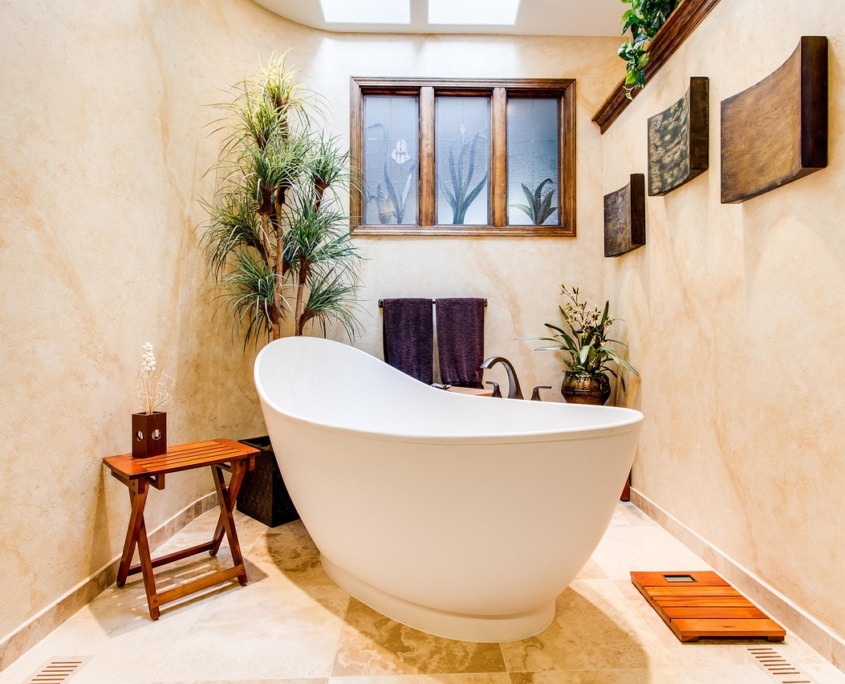
Warm earthy tones, grounding and centering.
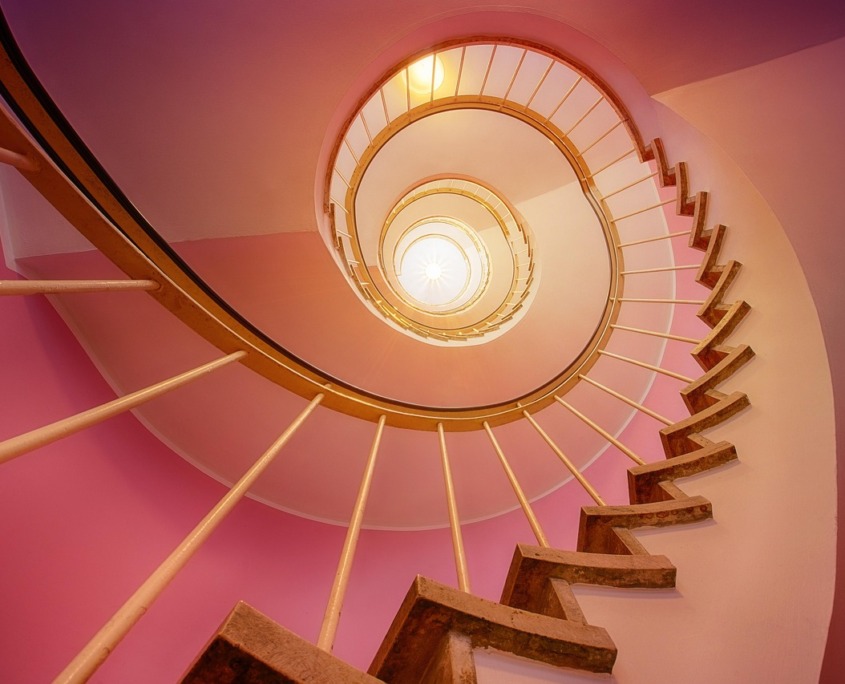
Pink, salmon, and rose, dynamic and activating.
A Practical Reference: Color Qualities for Wellness Environments — Held Lightly
What follows is offered as a set of tendencies drawn from research and contemplative tradition — not a formula, and not a universal map.
In practice, what a color does in a specific space, for a specific person or community, can be entirely individual and sometimes directly contrary to these general patterns. A decade of working with practitioners, organizations, and spaces has made this clear: the right palette for a meditation center in Berkeley is not automatically the right palette for a functional medicine clinic in Manhattan, or a private therapy office in London, or a retreat center in the mountains. The people, the mission, the quality of light, the existing materials, the cultural context — all of these shape what is actually needed.
These tendencies are a starting point for conversation, not a conclusion. The real color work happens in dialogue with the practitioner, the space, and the community it serves.
Blues and blue-greens tend toward calm, trust, and reduced arousal. Consistently effective in consultation rooms, therapy spaces, and meditation environments — but the quality of the blue (warm or cool undertone, light or saturated) matters enormously and responds to the specifics of each space.
Greens tend toward nature, restoration, and balance. Widely effective across wellness contexts, particularly for longer-stay environments. But green ranges from the living luminosity of new growth to the muted containment of deep forest — these are very different qualities in a room.
Earth tones and warm neutrals tend toward grounding, comfort, and belonging — well-suited to reception areas and communal spaces. The warmth of the undertone and the quality of the material it appears on will shift its effect significantly.
White and light tones tend toward clarity, openness, and stillness. Powerful as a ground that allows light and art to carry the room — but highly sensitive to context. Without warmth from materials or art, white can read as clinical distance rather than spacious clarity.
Gold and luminous surfaces operate differently from pigmented color — they introduce luminosity rather than hue, and respond to light throughout the day. In Steiner’s terms they are not image colors but something closer to light made material. Powerful in focal artworks for almost any healing environment, but need to be calibrated to the quality of natural light in the space.
Saturated warm colors tend toward arousal and stimulation. Valuable in communal and transitional spaces in moderation. Approached with care in rooms where patient anxiety is the primary concern — though again, individual and cultural variation is significant here.
The most important question in any color conversation for a wellness environment is not “what does this color mean?” but “what does this person, this organization, this space need — and what palette, including the palette introduced through art, best holds that intention?”
What Ancient Traditions Already Knew
For designers and consultants specifying art for wellness environments, color is one of the primary levers available — and art offers palette possibilities that painted walls cannot. A single large-scale painting with a luminous blue-green field, a gold-anchored base, and soft earth tones in the middle register can introduce a complete color story into a space without requiring the walls to carry all that work.
This is worth thinking about in terms of sequencing. Walls establish the broad ground. Art introduces complexity, depth, and focal resonance within that ground. When art and wall palette work together — when the art both relates to and elevates the surrounding color environment — the result is a space that feels designed rather than assembled.
Some questions worth considering when specifying art for a healing environment:
Does the palette of the artwork support the function of this particular room? A consultation room and a communal gathering space have different requirements. The first calls for calm, settled presence. The second may welcome more warmth and vitality.
Does the artwork introduce luminosity — a quality of light within color — or simply add more color to the room? Luminosity is often what separates art that transforms an environment from art that merely occupies it.
Does the palette have depth — a range of tones that reward continued looking — or is it flat and immediately resolved? In a space where the artwork will be encountered daily, palette depth determines whether the work continues to offer something or becomes invisible.
Archetype & Hourglass creates site-specific paintings and large-scale installations for wellness environments, retreat centers, and spaces of healing and reflection. Color, luminosity, and material depth are central to every commission.
ARCHETYPE & HOURGLASS
Art created from sustained inner attention, for spaces that support restoration and reflection.
For individual collectors, please visit:
yohannajessup.com
Archetypal Notes
Subscribe to receive writing on art, environment, and the relationship between inner states and the spaces we inhabit.
 © Yohanna Jessup - Archetype & Hourglass