
Geometry as a Living Language: The Role of Geometric Proportion in Healing Environments
There is a particular quality of stillness that certain spaces produce — a quality distinct from mere quietness. It is the stillness of a space that feels ordered at a level beneath conscious recognition. A cathedral nave. A Japanese meditation garden. A room proportioned with unusual care. Something in the arrangement of form tells the nervous system: this place was made with understanding.
The language underlying that understanding, across many of the world’s great spiritual and healing traditions, is geometry.
Not geometry as taught in school — the abstract manipulation of shapes and measurements — but geometry understood as the visible expression of relationships that govern living systems: the spiral of a shell, the branching of a river delta, the arrangement of seeds in a sunflower, the proportions of the human body. These patterns recur across scales and across species because they are not invented. They are discovered. And when they are brought into designed spaces — whether through architecture, through art, or through the deliberate arrangement of form — they produce a quality of resonance that we register before we can name it.
Geometry does not need a qualifying adjective to carry this dimension. It simply is what it is — as a tree is simultaneously practical material and something that opens onto a larger reality. Both are true at once, without contradiction. Understanding why geometric proportion works the way it does has direct implications for anyone designing environments where human beings need to be present, open, and alive to their experience
What Geometry Does to the Brain
The brain is a pattern-recognition system. Before any conscious evaluation occurs, the visual cortex is processing the structural relationships in whatever we are looking at — identifying regularities, detecting symmetries, sensing coherence or its absence.
Research in environmental psychology has found that spaces with clear visual order — harmonious proportions, coherent structural relationships, absence of visual noise — consistently produce lower measures of anxiety and cognitive load than visually fragmented environments. We experience ordered spaces as safer and more restful, not because we have decided they are, but because the visual system registers coherence as a signal that the environment is predictable and non-threatening.
This is part of why biophilic design has gained traction in healthcare and wellness architecture: natural forms carry the kind of structured complexity — what researchers call soft fractals — that the brain finds neither overstimulating nor understimulating. A fern frond, a coastline, a rose — these hold visual interest without demanding effort. They are organised without being rigid.
Geometric proportion operates through a similar mechanism to natural form, but with greater intentionality. Where natural forms carry geometric order as an emergent property of growth, proportion introduced deliberately into a designed space or artwork brings that order as a conscious compositional principle. The result, when it is handled with understanding, is a space or artwork that the brain processes as both coherent and alive — settled without being static.
e
e
The Traditions That Understood This
The use of geometric form in sacred and healing spaces is not a modern discovery. It is one of the most consistent design principles across otherwise very different traditions.
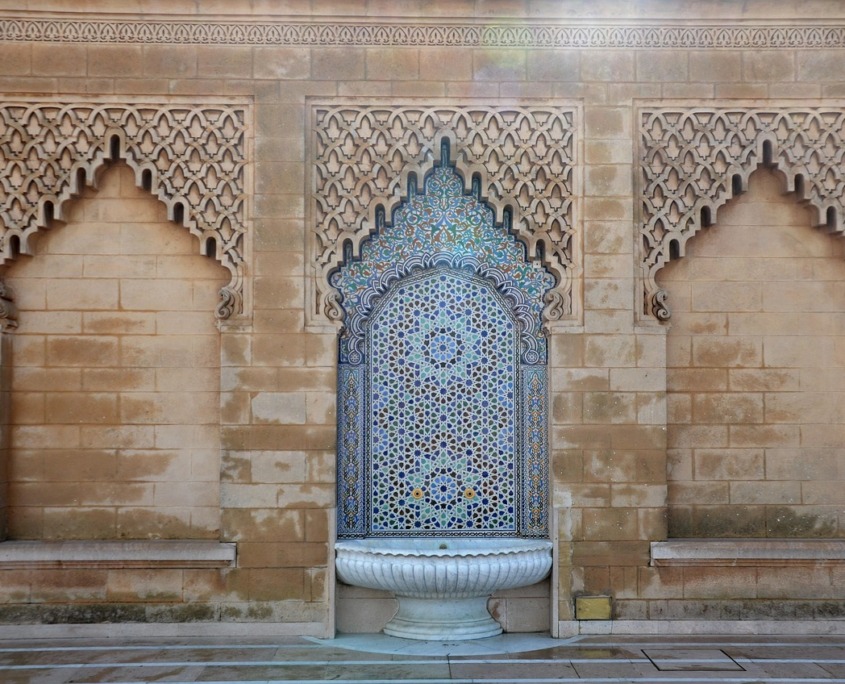
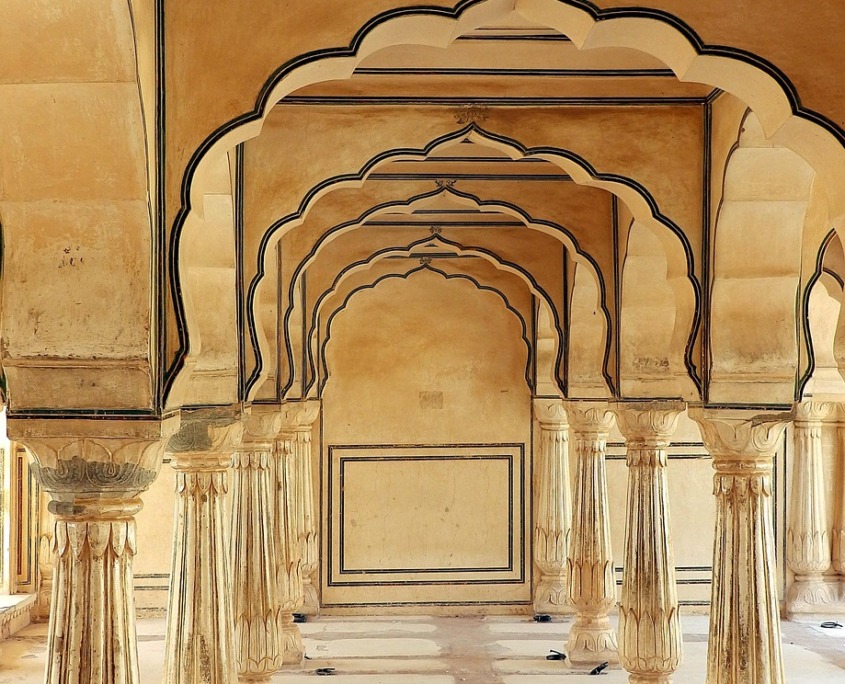
Islamic geometric art — the intricate tilework and architectural ornament of mosques and madrasas — was not decorative in the dismissive sense. It was understood as a visual expression of divine order and the infinite. The geometric patterns, which can be extended infinitely in any direction, were designed to evoke the boundlessness of the divine through the finite medium of tile and plaster. Spending time in a space ornamented with these patterns produces a specific quality of attention — absorbed, quietly active, not unlike meditation.
The mandala tradition in Tibetan and Hindu practice is perhaps the most explicit example of geometry as a tool for consciousness. Mandalas are not simply beautiful arrangements of shape and color. They are maps of inner states, created and contemplated as practices of centering and integration. The radial symmetry draws the eye inward toward the center — and the mind follows. This is intentional. The geometry is the practice.
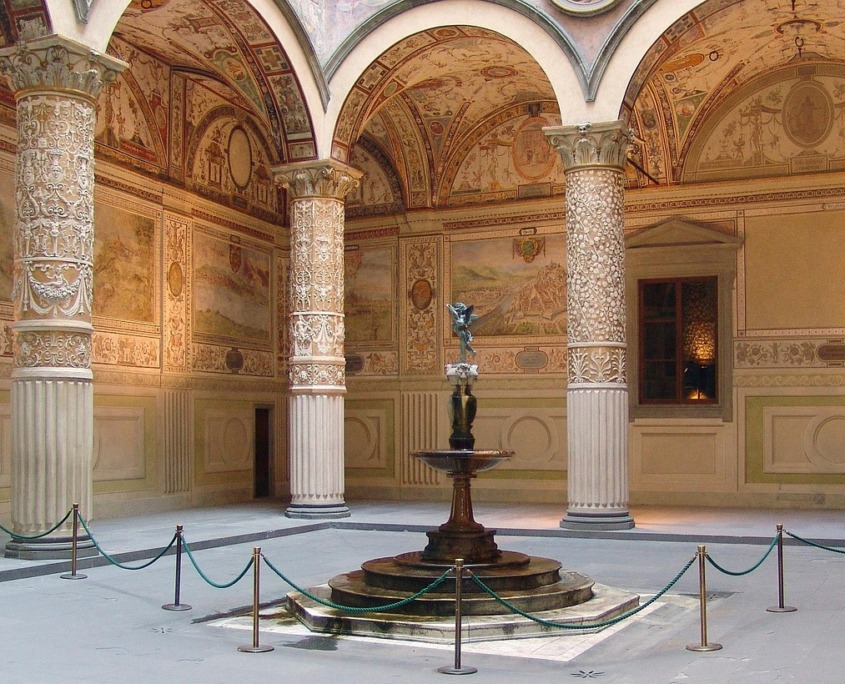
Gothic cathedral architecture applied mathematical proportions — particularly ratios derived from the geometry of the pentagon and the golden section — to produce interiors that evoke awe and vertical aspiration. The proportions were understood not merely as structural solutions but as expressions of cosmic order made visible in stone. The sense of transcendence these spaces produce is not accidental. It is geometrically engineered.
Feng shui and Vedic spatial design both contain geometric principles governing the proportions of rooms, the placement of objects, and the orientation of spaces relative to cardinal directions and natural forces. The underlying understanding is the same across these very different traditions: the geometry of a space affects the quality of experience within it.
The Golden Ratio and Why It Keeps Appearing
Among the geometric relationships that recur most consistently across sacred traditions and natural systems is the golden ratio — approximately 1:1.618, often denoted by the Greek letter phi. It appears in the proportions of the Parthenon, in Leonardo da Vinci’s studies of human proportion, in the arrangement of leaves around a stem, in the spiral of nautilus shells, and in the structure of DNA.
Research on aesthetic preference has consistently found that compositions incorporating golden ratio proportions tend to be experienced as more pleasing and harmonious than those that do not — though this is not a rigid rule and is modulated significantly by cultural context and individual variation.
What matters for the design of wellness environments is less the specific ratio and more the principle it represents: that certain proportional relationships feel right at a level that precedes intellectual evaluation. A room with well-considered proportions, a painting with a composition that honors geometric relationships, a space in which the placement of art relates thoughtfully to the architecture around it — all of these register as harmonious in a way that measurably reduces cognitive effort and supports the kind of open, settled attention that healing environments are designed to facilitate.
Geometry in Art for Healing and Reflective Spaces
Within painting, geometric form has a specific function in environments designed for healing, inner attention, and reflection. It is not primarily a decorative choice. It is a structural one — a way of organising visual experience so that the eye is guided, the mind settles, and the work continues to offer something on repeated encounter.
Several geometric principles are particularly relevant for art specified or commissioned for wellness environments:
Radial symmetry and central focus. Compositions that radiate from a clear center — whether explicitly structured like a mandala or more subtly organised — draw the eye inward and provide a natural resting point for attention. This is the visual equivalent of what meditation teachers call an object of practice. The gaze returns, the mind follows, and a quality of settled presence develops over time.
The spiral. One of the most consistent geometric forms in nature, the spiral represents both expansion and return — growth that maintains its center. In a space designed for healing and integration, the spiral carries a quality of movement without displacement. It arrives at and departs from the same center. This makes it a particularly resonant form for environments where clients are navigating significant change or transition.
Proportional relationships between elements. Within a painting, the relationship between geometric elements — the size of one circle relative to another, the distance between a central form and the edge of the canvas, the ratio of gold field to pigmented surface — creates a structural coherence that registers without being consciously decoded. When these relationships are well-considered, the work has an internal logic that the viewer senses as presence.
The relationship of the artwork to the space. Geometry extends beyond the canvas edge. How a painting’s proportions relate to the wall it occupies, how its center aligns with the sightlines of those in the room, how its scale relates to the scale of the space — these are geometric decisions that affect whether the work anchors the space or simply occupies it.
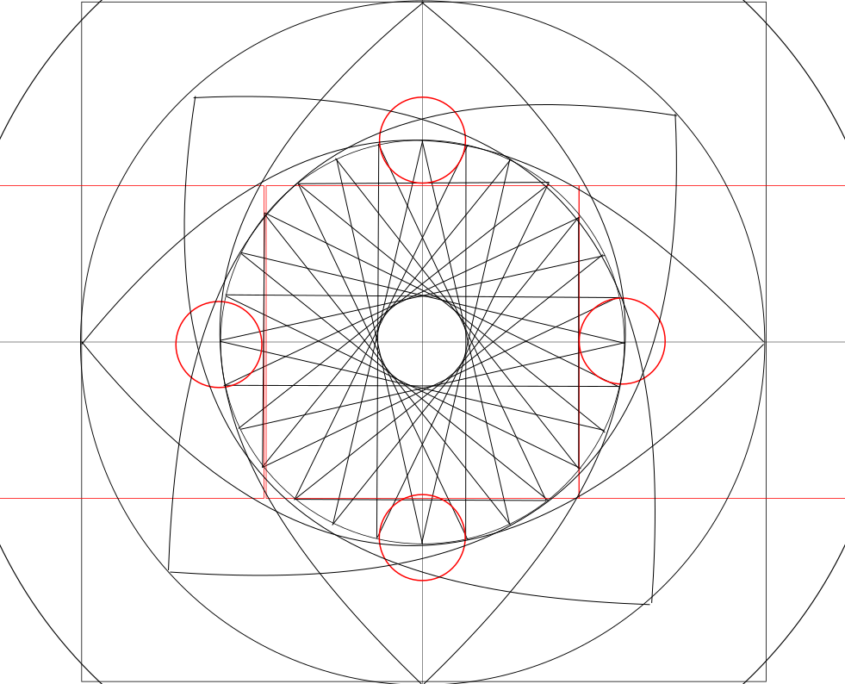
The ‘Cosmological circle’ geometry underlying “Peace Rose” composition.
The Geometry Beneath Peace Rose
The geometric scaffold image shared here reveals something that is not visible in the finished painting but is present in it nonetheless — the structural order beneath the surface that gives the work its quality of settled coherence.
‘Peace Rose’ — the 18 ft × 6 ft commission created for a Berkeley meditation center in 2022 — was developed using the geometric principles in Michael S. Schneider’s ‘Constructing the Cosmological Circle’, volume five of his series on the mathematical archetypes underlying nature, art, and sacred architecture.
The Cosmological Circle diagram is described by Schneider as a visual representation of the harmony inherent in the numbers 1 through 12 — a geometric construction that reconciles circle and square, heaven and earth, the ideal and the material. It has appeared across cultures in the design of temples, mandalas, kivas, and cathedrals — spaces built with the explicit understanding that geometric proportion creates a specific quality of presence in a room.
Looking at the geometric scaffold of ‘Peace Rose’, the structure becomes visible: three panels in careful proportional relationship, four circles placed at the cardinal points — above, below, and to each side — the whole composition organized around a central vertical axis. This is not decorative geometry. It is constructed cosmological order. The circles at the cardinal points create a sense of orientation and containment that the viewer feels without being able to articulate. The vertical axis gives the work its quality of aspiration and ground simultaneously. The three-panel structure creates rhythm — a visual breathing that moves through the work without disrupting its stillness.
This geometric foundation is part of what allows ‘Peace Rose’ to hold an 18-foot space without overwhelming it. The order beneath the surface gives the eye somewhere to rest and return, again and again, across years of daily encounter.
Steve Bass, in ‘Beauty, Memory, Unity: A Theory of Proportion in Architecture’, proposes that beauty is not primarily a quality of surfaces but a state the soul achieves when it recognises the phenomenon of unity — and that proportion, the use of number and geometry as design tools, is the means through which that recognition is made possible. Bass’s work, deeply informed by the Pythagorean and Platonic traditions and by his studies with geometer Keith Critchlow, argues that ancient architects and artists possessed a way of striking what he calls “resonant chords” in those who encountered their work — and that this capacity has been largely lost in modern design precisely because the geometric and proportional principles that enabled it are no longer understood or practiced.
‘Peace Rose’ is an attempt to recover something of that practice in a contemporary context. The geometric scaffold is not visible in the finished painting. But it is present — as the order that makes the painting work.
What This Means in Practice
For interior designers and art consultants working with wellness environments, the geometric dimension of art specification is often underweighted relative to color and subject matter. But it deserves equal attention — because geometry is what determines whether an artwork holds the space or disappears into it.
Some questions worth asking when evaluating art for a healing environment:
Does this composition have a clear center of gravity — a point toward which the eye is drawn and to which it can return? In a room where patients or clients will spend extended time, this matters enormously for the felt quality of the space over time.
Does the geometry of the work feel alive or rigid? Proportion used well is not grid geometry. The best geometric compositions in art for healing environments carry the organised complexity of natural form — structured but breathing, precise but not mechanical.
How do the proportions of the work relate to the proportions of the space? A painting that is geometrically well-considered in isolation can still feel wrong in a particular room if the proportional relationship between work and wall is not also considered.
Is the geometry visible or felt? The most effective geometric compositions in healing environments are not those that announce their structure, but those where the structure is sensed rather than seen — where the viewer feels the coherence without being able to immediately articulate why the work feels so settled.
These are not questions with formulaic answers. They are questions for dialogue — between artist, designer, and the specific space and community the environment is being created to serve.
Yohanna Jessup’s painting practice is rooted in geometric proportion, meditation, and a deep engagement with universal symbolism. Her large-scale commissions for wellness environments bring structural order and luminous presence into spaces designed for healing, reflection, and community.
Recommended Reading
“Constructing the Cosmological Circle” Michael S. Schneider (Volume 5 of ‘Constructing the Universe’ series). The geometric principles underlying the Cosmological Circle diagram and its appearances in sacred art and architecture across cultures.
https://www.constructingtheuniverse.com/Volume5.html
“A Beginner’s Guide to Constructing the Universe” Michael S. Schneider. An accessible, illustrated journey through the mathematical archetypes of nature, art, and science — numbers 1 through 10 as the code underlying natural and sacred form.
https://www.amazon.com/Beginners-Guide-Constructing-Universe-Mathematical/dp/0060926716
“Beauty, Memory, Unity: A Theory of Proportion in Architecture” Steve Bass, with foreword by Keith Critchlow. A Pythagorean and Platonic approach to proportion as the means through which art and architecture achieve the quality of beauty — and the soul recognises unity.
https://www.amazon.com/Beauty-Memory-Unity-Proportion-Architecture/dp/1584209674/ref=sr_1_1?nsdOptOutParam=true&sr=8-1
© Copyright Yohanna Jessup – Archetype & Hourglass
